

Hey everyone,
I had a call last week with a founder of an AI-native go-to-market SaaS company. I asked her what the state of marketing is across the B2B landscape, and she said this:
“There’s no sense of calm in the room right now. Even at the companies that are performing well.”
Her customers are the largest, most-funded and most innovative companies in the world, yet they feel that incapable of aligning their GTM strategy with the complex, ever-changing buying behavior.
The question for companies like Journey, our customers who are small founder-led B2B services companies, and non-technical B2B companies with very limited marketing resources is this:
How do we build a profitable business that grows predictably with a go-to-market environment that puts marketing and sales leaders in a panic?
the panic is real
She walked me through the symptoms of a panicked company in real time. More rebrands than she’s ever seen. Companies launching products at a cadence that doesn’t make sense. Big companies cloud-chasing little ones, something they used to ignore. CEOs in the weeds on decisions they used to delegate. AI SDRs everywhere, because nobody can afford to miss a single lead.
“I used to spend 20 hours building one deck. Now with Claude I can produce 100 decks. So I produce 100 decks. Which is the wrong way to think about it.”
That’s the panic loop in one sentence. Everybody got faster, so the bar moved to “more.” Now everybody’s drowning in their own output and nobody knows what’s actually working.
The instinct in panic is to reach for the lowest-hanging fruit. Move spend from one channel to another. Swap a tool. Run another rebrand. Ship more decks. None of those are wrong, exactly. They’re just stitches. The bleeding has a deeper cause.
what actually changed
The deeper cause is that buyers changed and we kept marketing like they didn’t.
A few numbers I’m sure we’ve all read somewhere on a LinkedIn post:
67% of B2B buyers prefer a rep-free buying experience. That’s from a Gartner survey in March 2026. Up from 61% the year before.
80% of B2B buyers complete ~70% of the buying journey before they ever talk to a sales person. From the Demand Gen Report. And it’s the buyer who initiates the first call, not us.
AI now covers 65-75% of that independent research. Pedowitz Group. The shortlist is being built in 10 minutes inside ChatGPT, with no human involved.
HubSpot’s customers saw a 27% drop in organic traffic year over year, while AI-driven traffic converts higher. That’s HubSpot’s own data, April 2026.
58.5% of Google searches end with zero clicks because AI Overviews answer the question before the user thinks about scrolling.
The shortlist is built before you know there’s a deal, which means those early decisions are being made with whatever buyers can find on their own.
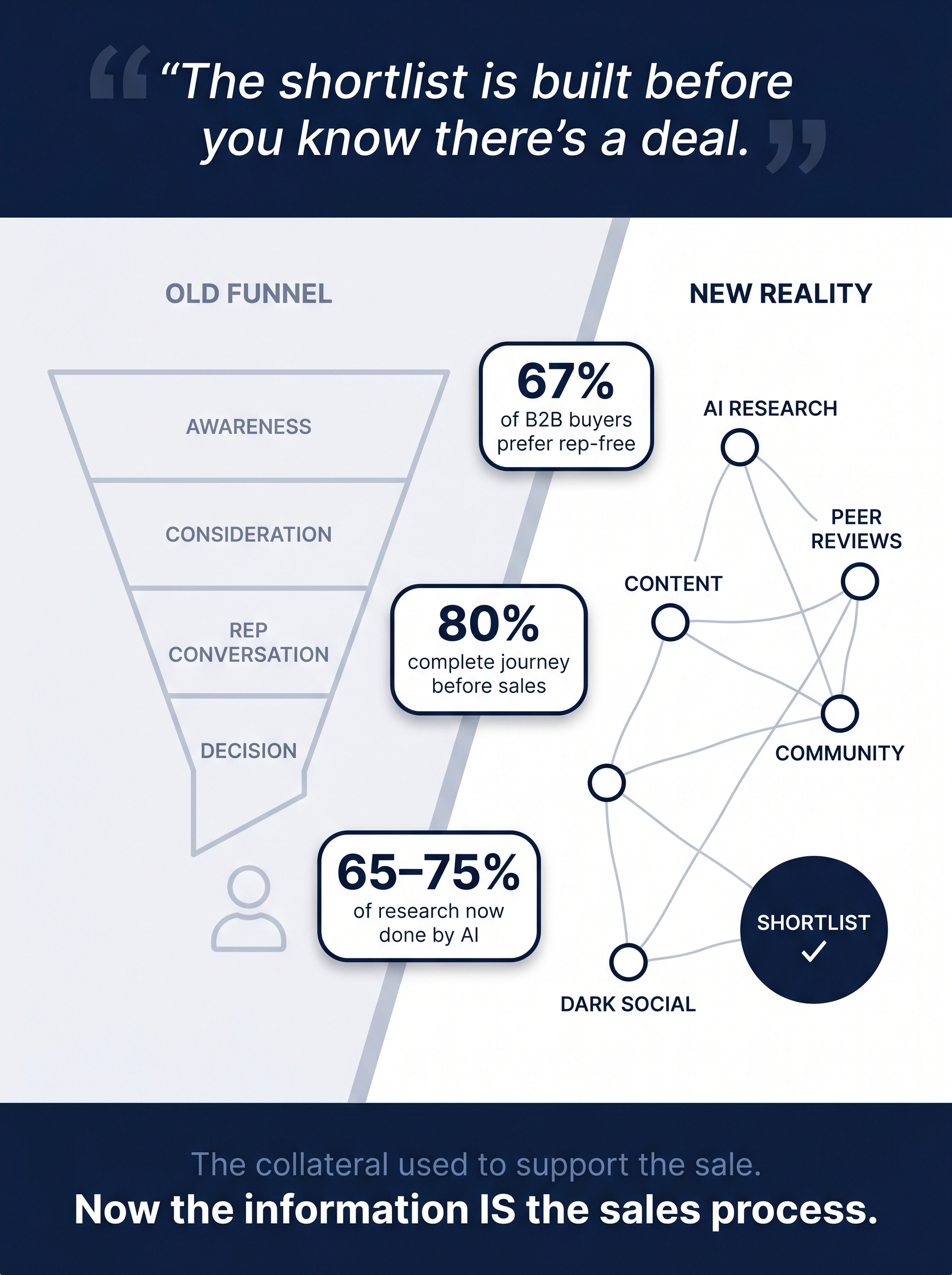
As a result, the first conversation isn’t that discovery call (or Assessment Call, which is what how I learned it). Instead, that first synchronous conversation is confirmation. By the time someone fills out your demo form or even trials your tool, they’ve already talked to ChatGPT, three peers in a Slack group, all the available content, and probably a Reddit thread.
This is the thing that is making me panic (along with every other more successful, more resourceful, and more intelligent operator): the funnel I built all my businesses on doesn’t exist anymore.
the value of information
Here’s why this applies to me, Journey.io, and our customers who use Journey.io to transmit information to clients, prospects, and others.
The vast majority of sales collateral was built for a world where a rep walked the buyer through the material. Decks, one-pagers, case studies, PDFs. The rep was the operating system. The collateral was the apps.
However, if 80% of the journey happens without a rep, the collateral is the operating system now. It has to work on its own. It has to be skimmable, interactive, trackable, and re-shareable inside a buying group without losing the plot.
A static PDF can’t do that. A 47-slide deck attached to an email can’t do that. A folder of links can’t do that.
Gartner projects 30% of B2B sales cycles will run through digital sales rooms by 2026.
86% of enablement leaders say their reps use less than 60% of available content because it’s stale, hard to find, or doesn’t fit the moment.
Buyers want short-form (67%) and webinars (65%). Appetite for “interactive content” actually dropped from 49% to 38%.
The translation: stop sending stuff. Start building experiences that travel through a buying group on their own.
how a small services company gets its name out in 2026
Most of my customers at Journey.io aren’t running enterprise marketing orgs with a Rolls-Royce GTM tech stack. They’re founders. Agency owners. Services teams running on Notion.
If 67% of buyers don’t want to talk to you, and 80% of the journey happens before they do, how does a five-person services company even get on the shortlist?
Here’s are two things:
1: the corporate voice is dying. Trust now flows from human practitioners, not companies and logos.
Eric Eden posted ~1,100 pieces of content on Reddit, racked up 21M reads, built 25K subscribers, and generated more inbound advisory work than most agencies do in a year.
Clay.com hit $100M ARR pumping out 3,000 pieces of content per quarter, most of it from partners and customers, not their in-house team.
The cheapest channel left is your face, your voice, and the unsolved problem you can’t shut up about.
2. be useful where the panic is. This was the most useful thing the founder said on our call. When she sees somebody post on LinkedIn or Reddit — “I’m trying these five things to get more traffic, none of them are working” — her team doesn’t pitch. They reply with information. A perspective. A diagnostic. Sometimes a free piece of analysis with no strings.
The pitch comes later. If it comes at all.
Build credibility by being the person who showed up before the deal existed.
what this means for what i’m building
Journey.io needs to find a space around this panic.
A Journey link replaces the file dump. One link, all the assets a buyer needs, structured like a story instead of a folder of files. It travels through the buying group without losing the plot. And on my side, I can see who opened it, what they read, how long they stayed, when they came back. The visibility I lost when buyers stopped talking to me is soemthing I get it back through the content itself.
The information isn’t the support material for the sales process. The information is the sales process.
That’s it for this one. Let’s keep it going.
Cheers, Danny