

Hey everyone,
I went on LinkedIn the last couple of weeks and downloaded every "free resource" I could find. Lead magnets, playbooks, templates — you name it. I just clicked the button, gave my email, and collected whatever landed in my inbox.
Out of maybe 50 downloads, I’d say four or five were actually useful. The rest felt like they were written by a prompt, not a person. Solid enough formatting. Nice enough design, but definitely felt like lacking.
It’s so easy to make “good enough” now that it’s everywhere…
fun stuff (before we get into things…)
had some great weather this past week (and not so great weather as well), but regardless, the boys were vibing and enjoying the nice March weather.
didn’t take any pictures this week.
content creation
There was a time when creating a solid case study, a polished one-pager, or a sharp product video required real resources. A designer. A writer. Budget. Prioritization. Most companies had client stories, usage data, industry reports, but getting it packaged into something usable was a bottleneck.
That bottleneck is gone.
Tools like Gamma and Canva can generate a deck in minutes. LLMs can write a first draft of nearly anything. The creation barrier basically evaporated.
I’ve been testing building custom Journeys for B2B services companies, and I took a company’s animation process and built it into a Google Slides and then used Google Slides video converter to have a walk-thru of our animation process (and added it to a Journey)
CMI’s latest report surveyed over 1,000 B2B marketers and the data tells the story clearly: 91% of B2B marketers increased their content output in 2025. But 39% say maintaining voice and quality is now their top challenge. 68% of B2B buyers say all brands look and sound the same.
So we’re producing more than ever. And it’s all starting to blur together.
the question i have
Content and resources are supposed to be one of the main mechanisms for building trust with prospects and customers. That’s the whole point — provide value, build the relationship, earn the conversation.
But if everyone has access to the same creation tools, and the volume of content keeps climbing, how do you actually stand out?
my dad
I’ve talked about this before, but it keeps proving itself true.
My dad runs a frame shop. When I bring him something meaningful, a photo, a certificate, whatever, he doesn’t just grab a frame off the shelf. He asks what story it needs to tell, then makes the presentation match the meaning.
If it’s valuable, he suggests museum glass so it preserves. If it’s something with texture and depth, he’ll built it into a 3-D shadowbox. If it’s a collection of items, he’ll add a name plate for context. Everything deserves the right packaging.
I think B2B content has the opposite problem right now. Companies are investing in creation but completely ignoring delivery. They’ll spend weeks building a great case study, then send it as a PDF attachment in a cold email with three other links and a “let me know if you have questions.”
All the intentionality they put into making the content gets destroyed by how they share it.
what I mean by packaging (and why I think it matters)
I built four sample Journeys last week for real prospects. Let me walk through what I did and why.
I took a video production agency, a water treatment company, a few others, and I went to their websites. I pulled their YouTube videos, their services pages, their process animations. Stuff they already had publicly available.
Then I took some of that raw material and used AI to build supplementary content, like turning a services page into a clean visual asset, or restructuring their animation process into something more digestible.
Here’s the key part: I packaged it all into a single Journey. One link. Everything sequenced intentionally: watch this video first, then see this breakdown, then here’s what working together could look like.
Compare that to the alternative: three YouTube links, a PDF, and a PowerPoint dropped into an email thread. Same content. Different experience.
With the Journey, I can see what they watched, what they skipped, how long they spent on each section. With the email dump, I’m just hoping they opened the attachment.
(You can see the four examples here: Snowy Peak · Cloud in the Sky · Sample 3 · AquaCycle)
the data says delivery matters, but the market isn’t acting like it
I had no idea if this is a real problem or just a me thing, so I went out looking for data to prove my point lol…
Gartner’s latest sales survey found that 67% of B2B buyers now prefer a rep-free buying experience. They’re self-educating, self-qualifying, and making decisions before they ever talk to a human. The content they consume during that process is the sales conversation for most of the journey.
6sense’s 2025 Buyer Experience Report found: 95% of the time, the winning vendor was already on the buyer’s shortlist on day one. And the vendor the buyer contacts first wins roughly 80% of deals.
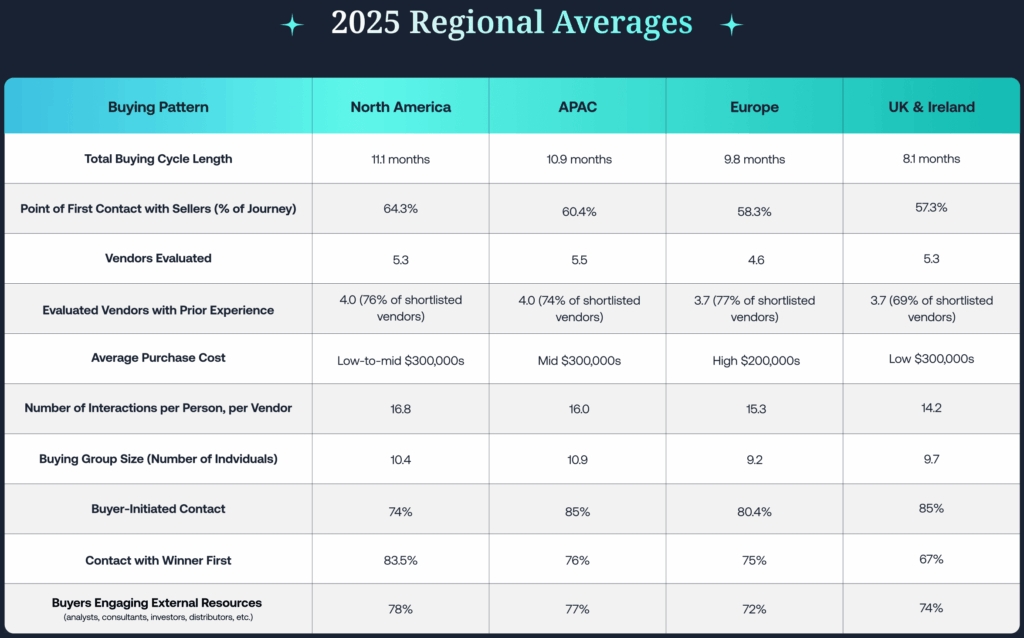
So the content you send before that first conversation isn’t just marketing collateral. It might be the most important sales interaction you have. And most companies are still delivering it as a pile of attachments.
Meanwhile, Gartner is telling enablement leaders to “structure content into modular, agent-ready building blocks that can be dynamically assembled into context-aware resources.” Not sure what that means exactly, but to a simple person like me, it’s translated to: stop sending static PDFs and start thinking about content as an experience you design.
back to PMF
Some of our customers at Journey completely agree with this. They see the packaging, the sequencing, the engagement data, and they get it immediately. The “aha” is instant.
Others don’t care. They’re fine sending the email with five attachments. And their deals still close.
So is this a real problem, or is it a problem I want to exist because it’s the one Journey solves?
I don’t know, but the experiment I ran, building those four prospect Journeys, taught me that the act of curating and sequencing someone else’s content forced me to actually understand their business.
The packaging process was the research process. And the output was something I could send that demonstrated I’d done the work, without ever saying “I did the work.”
That feels like it matters. Whether it matters enough to change buying behavior at scale is the question I’m still trying to answer.
what I think is true (but can’t prove yet)
Content creation is now table stakes. Every company can produce decent stuff quickly.
The next layer is how you collect disparate content into a single experience, how you prescribe what to consume and in what order, how you add context that makes each piece more valuable than it would be alone, and that’s where the gap is opening up.
When you send a bunch of links in an email, all the prescription gets lost. All the intentional sequencing disappears. And the insights about what your prospect actually engaged with? Gone.
I think that gap is going to mat
ter more, not less, as content volume keeps climbing. But I’m saying that as someone who builds a tool that addresses exactly this problem.
That’s it.
Let’s keep it going.
Cheers, Danny