

I recently sat down with Steve Brady to work on Journey’s go-to market. We spent nearly two hours dissecting our best customers, the ones who stay the longest and pay the most, and it led to a sobering realization.
The growth playbook I used to buy, operate, and sell 10 other SaaS businesses since 2021 is effectively obsolete.
As we navigate the path to Product-Market Fit (PMF) with Journey, I’ve had to confront the fact that what worked for B2B SaaS three years ago is now a recipe for stagnation.
Here is what I’m learning about the “New Playbook” and how our strategy is evolving in real-time.
fun stuff (before we jump into things…)
It’s been mayhem here at the Chu residence since last Friday when we got some rough weather here in Texas.
My 2 boys have been home from school since Monday, so they’ve been watching a lot of TV, fighting a lot, but also enjoying each other more than ever.
They are great, and my wife and I love seeing them grow up.

the volume trap vs. the efficiency reality
For a long time, the standard SaaS playbook was a “numbers game”: pump the top of the funnel with high-volume outbound, prioritize MQLs (Marketing Qualified Leads), and grind to close deals.
Why it’s broken now: In the current market, the “Volume Play” has hit a wall of diminishing returns. With the explosion of AI-generated outreach, buyers are drowning in noise. Research shows that the average B2B buyer is now 70–80% through their journey before they ever want to talk to a salesperson.
If your playbook relies on “booking the demo” to explain your value, you’ve already lost. We’ve realized that growth isn’t about how many people we message; it’s about the intent signal of the person who is struggling to manage a high-stakes narrative.
The struggle here is to identify what the intent signals are, how to actually track them effectively, and do something about it with the right message, at the right time, with the right people.
why “candy” SaaS isn’t so sweet anymore
During our session, Steve used a great analogy: “Candy” vs. “Complex.”
“Candy” software is simple, transactional, and low-stakes. You don’t need a manual to buy it. But the SaaS market is currently oversaturated with “Candy”, tools that provide minor convenience but no mission-critical ROI.
PLG used to sort of be a default for “candy” software because it wouldn’t make sense to sell a low ACV software product with expensive salespeople, but now you see Enterprise software execute a PLG motion and some of these lower priced products run consultative sales processes.
So what does that mean for Journey?
Our best customers are surprisingly in rather complex industries like Commercial Real Estate and Manufacturing. As a result, they aren’t looking for a tool; they are looking for Asynchronous Education.
When you are selling a multi-million dollar real estate fund or a 50,000lb industrial machine, you aren’t looking for a “quick transaction.” You need to educate a dozen people who are never in the same room.
“Candy” doesn’t solve that; a structured narrative does.
So how do we sell a low ACV product that looks like “candy” but needs to be perceived as a vibrant, complex creme brûlée lol.
build software to solve actual human problems
The old way to grow was to look at a competitor’s feature list and try to build a “better” version. We call this “Feature Parity Growth,” and it’s a race to the bottom.
We’ve realized that Journey’s growth doesn’t come from being a “better file sharer.”
It comes from solving a fundamental human stressor: Information Clutter.
In today’s software ecosystem, “Tool Fatigue” is real. The average enterprise uses over 100 SaaS apps. Most buyers don’t want a new tool to learn; they want their current problems to disappear.
When we ask, “Are you drowning your clients in PDFs?” we aren’t selling a feature. We are addressing a breakdown in human communication. By focusing on the problem (the mess) rather than the tool (the storage), we bypass the “budget fight” and move straight to the “value fight.”
I’m good at this on a sales call, where I can meet someone face to face and have a human to human interaction.
What’s hard and the “nut to crack”?
How do you communicate this same level of value asynchronously, on LinkedIn, on your website, with less than 5 words on your H1, with your blog content, and with your “product” without just being “another” digital sales room…
This is where it feels like the companies we see thriving have found their “secret sauce”.
The ability to resonate with actual human emotions.
“horizontal” mirage
When we bought Journey, it felt as broad as Google Slides.
There is a massive temptation in SaaS to build a “horizontal” tool, something for everyone. The logic is that a bigger TAM (Total Addressable Market) equals a bigger company.
Unfortunately, horizontal tools are becoming commodities. If you try to speak to everyone, your messaging becomes so diluted that you end up speaking to no one.
Vertical-specific growth almost feels like the only real opportunity to build a successful SaaS.
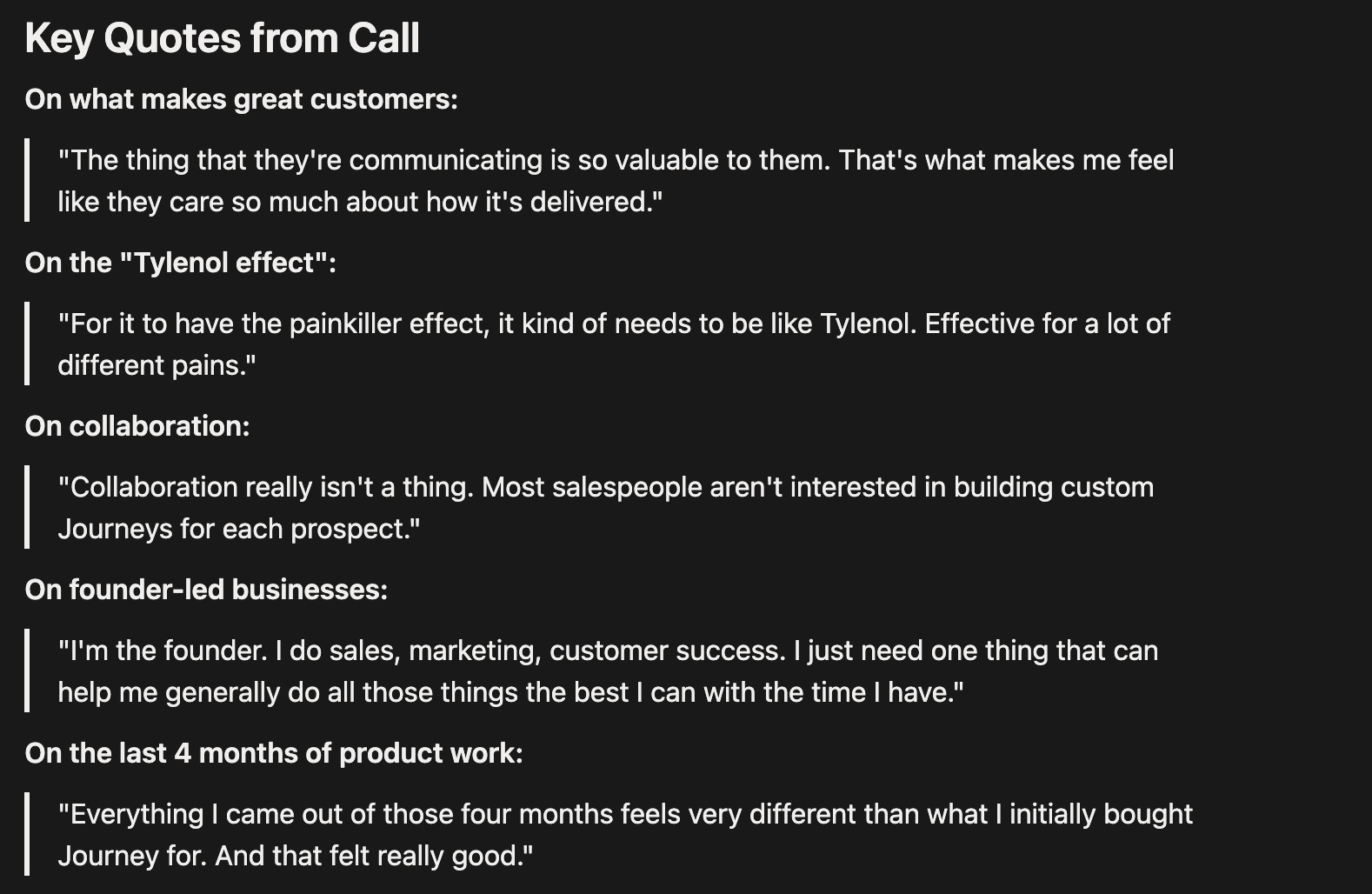
We are moving away from being a “sharing tool for anyone” to being a high-stakes communication platform.
In Finance, a lost attachment or an unread memo can cost a six-figure investment check.
In Manufacturing, a missing safety spec can halt a production line.
By narrowing our focus to these “high-stakes” verticals, we can build specific workflows that a horizontal tool like Google Drive or DocSend simply can’t touch.
the takeaway
The path to PMF isn’t a straight line. It’s a series of messy, sometimes uncomfortable realizations.
I’m learning that the real work is having enough self-awareness and then the courage to adjust the playbook even when it feels counter-intuitive to “shrink” your focus.
Have you noticed your “standard” playbook starting to crack lately? I’d love to hear your thoughts.
That’s it for this one. Let’s keep it going.
Cheers,
Danny