

Hey everyone,
Last week, someone shared the available snippet from Mark Roberge’s “The Science of Scaling”, and it gave me a chance to reflect on not the “what” or “how” I’m building, but “why”.
what i learned
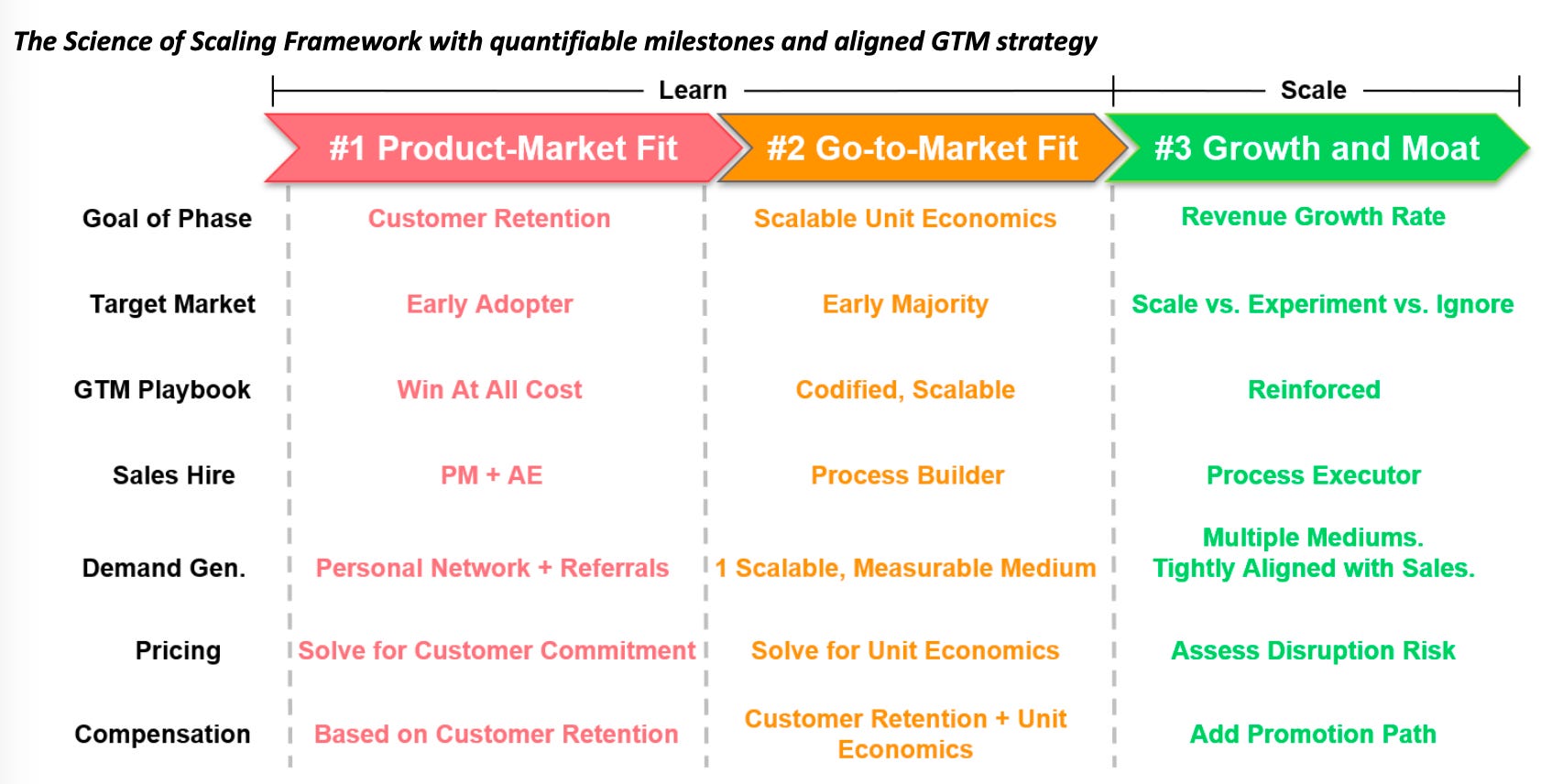
Reading Roberge’s work matured my understanding of four principles:
1. Customer Retention Comes Before Revenue Growth
Everyone says “triple, triple, double, double.” But that’s how you end up as a cautionary tale.
At Journey, we were hiring aggressively, building features fast, and chasing every lead. Meanwhile, customers were churning silently because we hadn’t nailed what made them successful.
Now we’re exploring how we might monitor and analyze a specific leading indicator: 70% of customers spending 3+ minutes exploring a journey and sharing it with their team within 60 days. This correlates with long-term retention. Then it should be our north star.
2. Product-Market Fit Needs a Number, Not a Feeling
“We have PMF” is usually a guess. I know because I made that guess.
The framework is simple: Pick a percentage (60-80%), an event (something customers do that creates value), and a timeframe (1-3 months). Then measure it obsessively.
For us: 70% of customers + 3+ min exploration + sharing + 60 days = PMF signal.
For Slack, it was 70% of customers sending 2,000+ messages in 30 days. For Dropbox, 85% uploading 1 file in 1 folder within 1 hour.
The specificity matters. It forces clarity.
3. Do Things That Don’t Scale, Longer Than You Think
This one changed my mindset completely.
We were obsessed with building scalable processes. Automated onboarding sequences. Self-serve flows. Templated everything.
But we hadn’t actually figured out what drives retention yet. So we were scaling the wrong thing.
We are taking a step back to get some more data points on this.
Once we nail that, then we build scalable processes around it. Not before.
what i’m trying to do differently
Based on all of this, here’s how I’m applying it to different parts at Journey:
1. Retention-First Roadmap We’re reorganizing our entire roadmap around that 70% leading indicator. Every feature, every improvement, every decision gets filtered through: “Does this help customers hit our success metric?”
2. Doubling Down on “Unscalable” Work I’m personally doing customer onboarding calls. Our product team is doing weekly check-ins with customers. We’re learning what actually drives value before we automate it away.
3. Messaging Clarity Over Feature Parity We’re not building 10 new features this quarter. We’re getting crystal clear on our positioning, testing it with intent, and making sure every customer we acquire is someone we can actually help.
for my friends
Here are questions I’m asking myself (that might be helpful for you, too):
What’s your customer retention leading indicator? (If you don’t have one, that’s your first project.)
Are you optimizing the right thing, or just making the wrong thing more efficient?
Are you still doing the unscalable work that teaches you what actually drives value?
The founders who win aren’t the ones who grow fastest. They’re the ones who grow sustainably, with customers who stick around.
That’s what I’m working towards…
Cheers,
Danny
ps - if you want to read the “Science of Scaling”, you can find it at stage2.capital/science-of-scaling.