

Four months ago, I brought on Gab (awesome dude btw), a product marketer who specializes in positioning and messaging. Journey.io, for a small start-up, had hundreds of signups weekly, but it wasn’t generating revenue. People weren’t converting. They weren’t staying.
The business was a consequence of a “Frankenstein of product-market fit.”
I thought the problem was optimization.
It wasn’t.
fun stuff (before we jump into things…)
I’ll save you a picture this time, but my 2-year old did “his business” on the little plastic toilet we have setup in the bathroom for the first time yesterday. He was so happy. His older brother was so happy for him, who was also doing “his business” on the regular toilet next to him.
Life is so fun with community. Even the small things, even the most uneventful things, can be memorable.
Same thing with building a business. It’s freaking lonely, especially when it’s not going well, so just putting yourself in a position to be around community, be around those that can give you energy and give you hope, are big factors to “winning” (imo).
traffic isn’t validation
Here’s some data around our previous website (we just launched our new one yesterday, 1/7/2026:
84% of our traffic was direct.
85% were new users.
They stayed for 8 seconds.
We were getting 400ish signups, but the conversion rate was abysmal.
My assumption was that the traffic is just unqualified.
The traffic is a Frankenstein. And I’m making decisions based on it.
The website reflected the years of pivots, unclear positioning, and horizontal product thinking had created a magnet for the wrong people.
Students with .edu emails looking for presentation tools. International users. People who had no business being there because we weren’t going to be the best fit for their needs.
The lesson: High traffic + low conversion means you need better targeting. My question was then how to stop trying to convert everyone and start attracting someone.
the positioning framework
Gab and I went through this exercise:
Use Case-Based Positioning
Instead of trying to be everything to everyone, he suggested narrowing it down to a specific use case.
For example,
“Following up after a sales call by sending a personalized, trackable package of content to re-engage buying committees asynchronously.”
This wasn’t about digital sales rooms. It was about asynchronous sales storytelling — helping sales teams tell a coherent story when they can’t be in the room.
The Messaging
We tested two variants:
Variant A: Onboarding-focused messaging
Variant B: Sales-led messaging
The results were stark:
80% higher response rate with sales messaging
56% of qualified prospects were explicitly seeking a sales engagement solution
Sales messaging won on cold outbound, LinkedIn, and direct response
This wasn’t a close call. The market was telling us something clear: people want this for sales, not for onboarding.
The experiment was one of many that we had on our list.
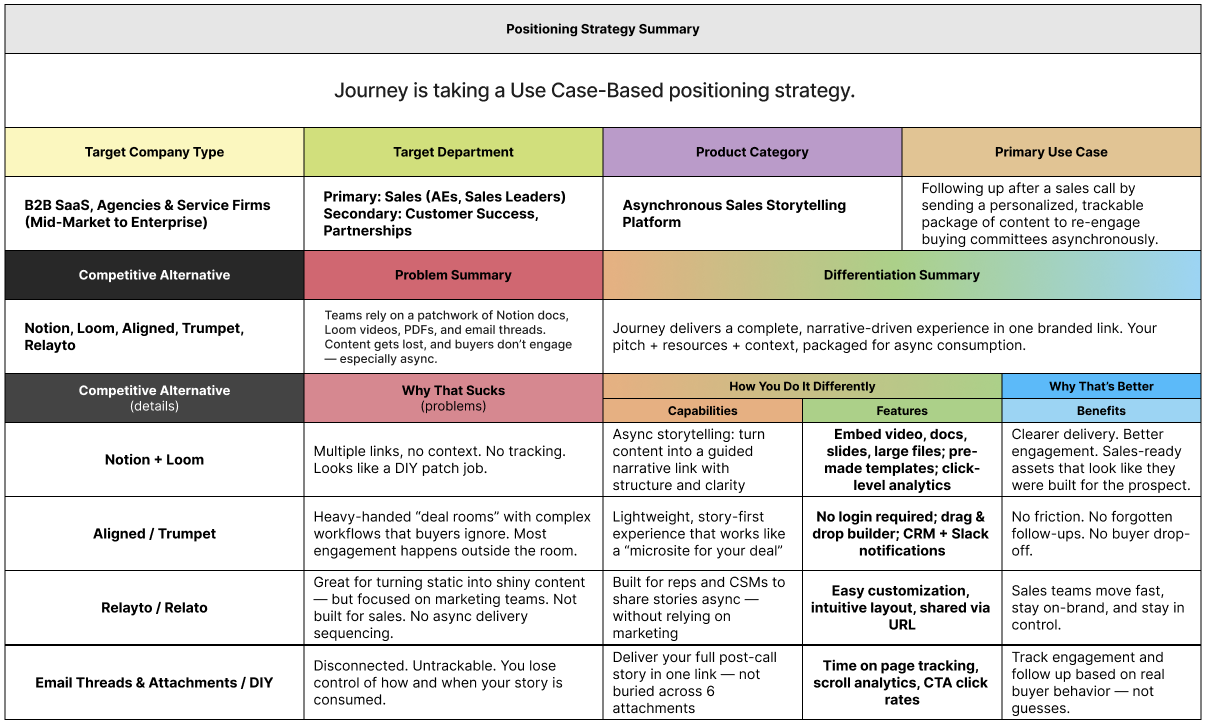
I’ll share more about this later, but we eventually realized that there needed to be even further narrowing beyond just use cases, so that’s where I am today (will write more about that soon).
what the struggles taught me through this
1. Churn Without Clarity
We had customers using Journey really well — thousands of views daily — and then they’d churn. No explanation. No pattern.
This taught me that horizontal products are hard to understand. When something can be used for anything, it’s hard to know why someone stops using it. We needed to get vertical.
2. The Traffic Trap
I was obsessed with homepage optimization. Gab pushed back: “You have 1.54 pages visited per session. You want 2.5. But you can’t get there by tweaking headlines.”
We ran an A/B test on the homepage. The new positioning increased outbound clicks from 0.08% to 8.52% — a 100x improvement. Same traffic volume. Different message.
The lesson: Messaging moves the needle more than optimization. Optimization of a “wrong” = “more wrong”.

3. My Incorrect Assumptions
I believed:
✗ More traffic = more opportunity
✗ Optimization = conversion
✗ Horizontal positioning = broader appeal
✗ Product quality alone = market fit
All wrong.
the real problem (and a qualified solution)
By the back half of 2025, I realized something crucial:
The amount of traffic we get and how unqualified that traffic is means we can’t just optimize our way out of this.
And by the way, let me clarify to say what I’ve been meaning by “optimization”.
Optimization is what you do when you know which direction to go. A mentor used to always remind me that start-ups die because they start scaling too fast and end up scaling the problem (and not the value).
The way we get out of this is by finding message-market fit.
We need to:
Stop attracting the wrong people — This means positioning so clearly that unqualified prospects self-select out
Get in front of the right conversations — Not just wait for people to find us
Build a long-term positioning bet — This isn’t a 3-month play. It’s years (or many, many months) of consistent messaging.
Test with intent — Use our traffic advantage to validate messaging, not just tweak copy
But here’s the thing: None of this matters if we don’t get in front of more qualified conversations.
The traffic we have is a liability if it’s the wrong traffic. So we’re shifting from “how do we convert more of what we have” to “how do we attract what we actually want.”
the takeaway
The real work isn’t optimization, it’s clarity. It’s knowing exactly who we’re for, why they need us, and how to reach them.
The traffic will follow. But only if we know who we’re trying to attract.
What I’m learning: Sometimes the best marketing advice isn’t “do more of what’s working.” It’s “stop doing what’s not working, even if it looks like it is.”
This is the work of the next quarter. Get in front of more conversations. Get clearer on positioning. Test with conviction. And stop mistaking traffic for traction.
That’s it for this one. Let’s keep it going.
Cheers,
Danny